By Zahid Hussain | Kitchen appliance reviewer & home cook
Of all the small toaster oven buying mistakes I see, getting the size wrong is the most common and the most expensive to fix, because nobody returns a toaster oven over a size problem. They just live with it, quietly annoyed, until it eventually gets replaced years later by something that actually fits their kitchen and their cooking.
Size confusion happens for a specific reason: toaster oven capacity isn't standardized the way, say, a refrigerator's cubic footage is. One brand's "large" is another brand's "medium," and marketing claims like "fits 6 slices of toast" or "fits a 12-inch pizza" don't tell you much about how the oven will actually handle your real cookware. This guide fixes that by giving you an actual measuring method, not just a vague size category to guess at.
How Toaster Oven Sizes Are Actually Measured
Short answer: the real unit that matters is interior cubic feet (or liters), not vague labels like "compact" or "family-size," which vary wildly between brands and aren't standardized.
Toaster ovens are typically sized by their interior cavity volume, measured in cubic feet in the US or liters elsewhere. A genuinely compact model sits around 0.3 to 0.5 cubic feet. A mid-size model lands between
0.6 and 0.9 cubic feet. A large or XL model runs 1.0 cubic feet and above, sometimes with two cooking levels rather than one.
The problem is that very few people shop by cubic feet, because it's an abstract number until you connect it to something concrete. A 0.5 cubic foot oven and a 1.0 cubic foot oven sound like they're just "different sizes," but the practical difference is closer to "fits four slices of toast and nothing larger" versus "fits a 14-pound turkey." That's the gap this guide is built to close.
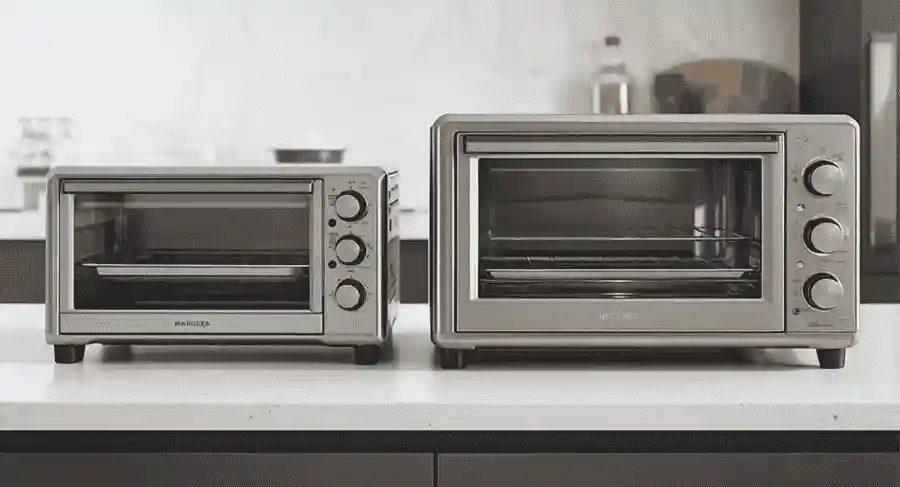
There's also a second, separate number that matters just as much and gets confused with interior capacity constantly: exterior footprint. A toaster oven's interior cubic footage tells you what fits inside it. Its exterior dimensions tell you whether it fits on your counter at all. These two numbers don't scale together in a predictable way, which is the subject of its own section below.
What Can You Actually Fit in a Small Toaster Oven?
Short answer: 4 to 6 slices of bread, a 9-inch pizza, and small individual portions — but not a standard 9x13 baking dish, a whole chicken, or a full sheet of cookies.
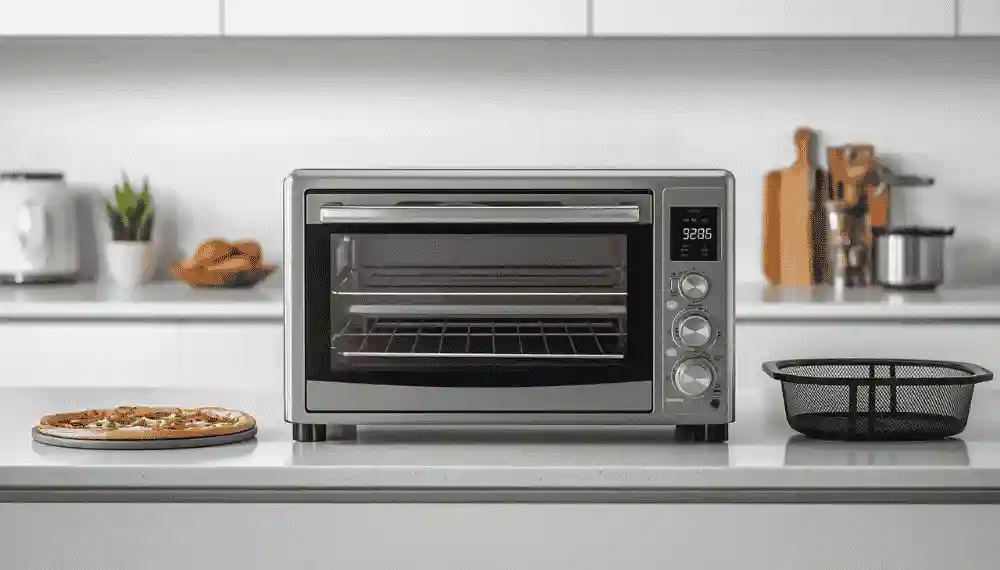
A compact toaster oven, typically in the 0.3 to 0.5 cubic foot range, is built around a specific use case: toast, bagels, reheating individual portions, and the occasional small bake. In testing the Panasonic FlashXpress, one of the most compact models on the market, the interior measured roughly 4.1 inches high by 10.2 inches wide by 9.8 inches deep — enough for 4 slices of bread or a 9-inch pizza, but genuinely too tight for anything larger.
This size category works well for: people living alone or as a couple, anyone whose toaster oven use leans heavily toward toast and reheating rather than baking or roasting, and kitchens where counter space is at an absolute premium. It works poorly for: baking more than a handful of cookies at once,
roasting a full tray of vegetables for more than two people, or fitting a standard 9x13 casserole dish, which simply will not clear the interior height and width of most compact models.
The single most common mistake with small toaster ovens isn't choosing one — it's choosing one and then trying to cook for more people than it was ever built to handle, leading to the toaster oven equivalent of cramming too much into a too-small suitcase: things half-fit, airflow gets blocked, and results suffer.
What Can You Actually Fit in a Large Toaster Oven?
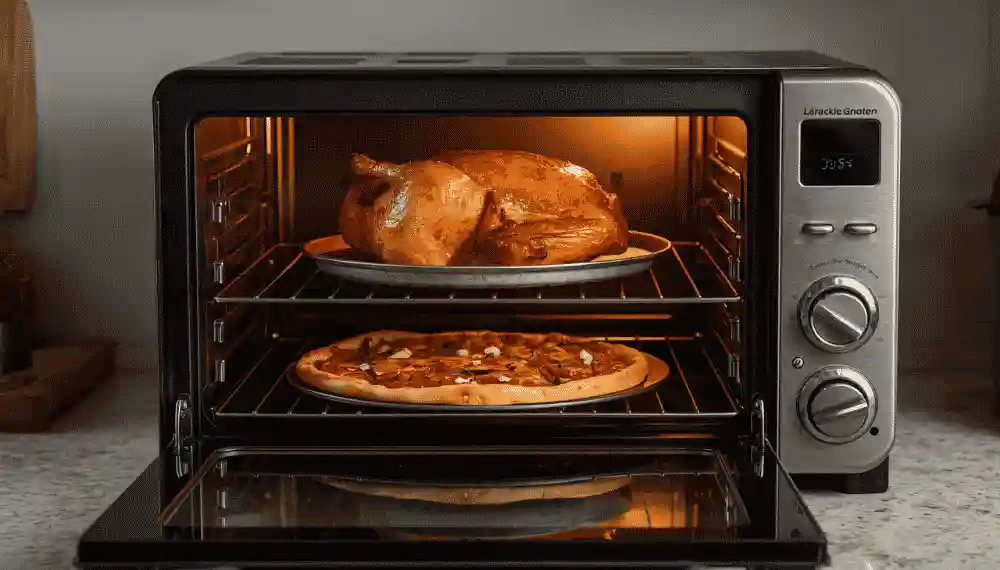
Short answer: a 12 to 14-inch pizza, a 9x13 baking dish, a whole chicken or small turkey, and in the largest models, two full trays cooked simultaneously on separate levels.
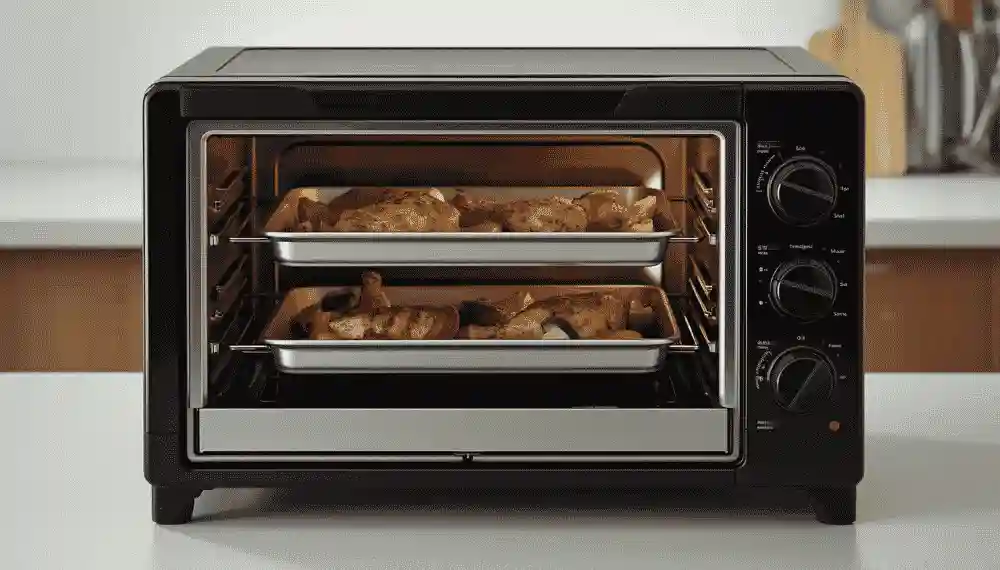
A large or XL toaster oven, generally 1.0 cubic feet or more, is built to genuinely compete with a portion of what a full-size oven does. In testing the Breville Smart Oven Air Fryer Pro, the 1.0 cubic foot interior comfortably fit a 14-pound turkey, a 13-inch pizza, and a full 12-cup muffin tray. The Ninja Foodi DT201 goes a step further with two independent cooking levels, allowing a full tray of chicken and a separate tray of vegetables to cook at the same time without rotation.
This size category works well for: households of three or more, anyone who regularly bakes or roasts rather than just toasting and reheating, and situations where the toaster oven needs to genuinely reduce how often the full-size oven gets used. It works poorly for: small kitchens with limited counter space, since these units commonly measure 18 to 22 inches wide and can weigh 20 pounds or more, making them a permanent counter fixture rather than something you tuck away between uses.
The most common mistake here runs the opposite direction from the small-oven mistake: buying more capacity than you'll regularly use, then discovering the unit is too heavy and bulky to store away, so it ends up dominating counter space it didn't need to occupy for the amount of actual cooking happening inside it.
How to Measure Your Own Cooking Needs Before Buying
Short answer: measure your three most-used pans and dishes, not the toaster oven — the oven needs to fit your cookware, and most buying mistakes happen because people measure the appliance instead of their own kitchen habits.
This is the step almost every toaster oven buying guide skips, and it's the one that actually prevents size regret. Before looking at any specific model, take ten minutes to do this:
Measure your most-used baking sheet or pan. Pull out whatever you bake or roast in most often — a half-sheet pan, a 9x13 casserole dish, a muffin tin — and measure its length and width. This number matters more than any marketing claim about pizza size, because it's the dish you'll actually be sliding in and out regularly.
Count how many people you're typically cooking for in one sitting. Not how many people live in your home necessarily, but how many servings you actually prepare at once. A single person who frequently hosts dinner for four needs different capacity than a family of four who mostly eats in shifts.
Identify your single largest occasional-use item. Even if you don't roast a whole chicken every week, if you do it twice a year, that's worth accounting for. A small toaster oven that handles 95% of your cooking
perfectly but can never accommodate the other 5% means falling back on a full-size oven (or buying a second appliance) for those occasions.
Measure your actual available counter space, not just where you imagine the oven going. Use a tape measure on the literal spot, accounting for the cabinet door swing above it if there's an upper cabinet, and the ventilation clearance most manuals recommend on the back and sides.
With those four numbers in hand, comparing toaster oven interior dimensions against your specific pan and your specific counter space turns size selection from a guess into a measurement-based decision.
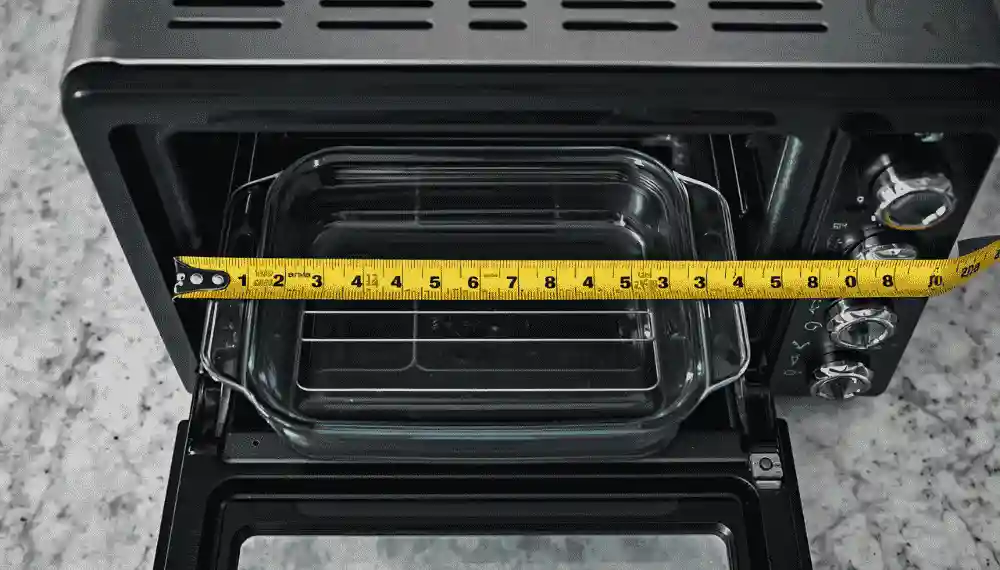
Counter Footprint vs. Interior Capacity: Why They Don't Scale Together
Short answer: a toaster oven's exterior size and its interior capacity are related, but not proportionally
— a taller, narrower model can have less usable interior than a flatter, wider one with a smaller-looking exterior, so never assume one tells you the other.
This is a genuinely underappreciated wrinkle in toaster oven shopping, and it trips up more buyers than almost anything else covered in this guide. Manufacturers make real design tradeoffs between exterior footprint and interior usable space, driven by wall thickness, insulation, and where they place the heating elements and any internal fan housing for convection models.
A practical example from testing: the Our Place Wonder Oven has a relatively compact-looking exterior, but its 0.55 cubic foot interior is tight enough that a 9-inch pizza is a genuinely close fit — tighter than its exterior size might suggest at a glance. Meanwhile, some larger-looking models lose a meaningful amount of interior space to thicker insulation walls or a bulkier door mechanism, meaning the gap between "how big it looks on the counter" and "how much you can actually cook inside it" varies more than most buyers expect.
The practical fix: never buy based on exterior dimensions or visual size alone. Always check the manufacturer's listed interior cubic footage and, where available, the specific maximum pizza size or baking dish compatibility, and cross-reference that against the measurements you took in the previous section.
What Happens When You Get the Size Wrong (Both Directions)
Short answer: undersizing leads to batch-cooking frustration and food that doesn't fit; oversizing leads to a bulky, hard-to-store appliance that dominates counter space relative to how much you actually use its full capacity.
Getting size wrong isn't a minor inconvenience in either direction — it changes how you actually use the appliance day to day, often in ways that quietly push people back toward their full-size oven instead.
Under sizing consequences: The most direct cost is batch cooking. A toaster oven too small for the portion you're preparing forces you to cook in multiple rounds — load it, cook, unload, reload, cook again — which erases much of the time-saving advantage a toaster oven is supposed to offer over a
full-size oven. We measured this directly when comparing toaster oven and air fryer capacity for a family of four cooking chicken thighs: the same batching problem shows up when comparing toaster ovens to air fryers, and it shows up just as clearly when comparing a too-small toaster oven against a properly sized one. A 35-minute single-pass cook becomes a 55-minute multi-batch ordeal, with the first batch cooling while the second cooks.
Oversizing consequences: The cost here is less about cooking performance and more about daily friction. A large toaster oven that's genuinely too big for your actual cooking volume becomes a permanent, heavy counter fixture — most large models in the 18 to 22 pound range aren't something you casually move to free up counter space, the way you might with a 7-pound compact model. Over time, this often means a sizable appliance sitting mostly underused, taking up real estate that could have gone to literally anything else, while a smaller oven would have handled the actual day-to-day cooking just as well.
Weight and Storage: The Sizing Factor Nobody Mentions Until It's a Problem
Short answer: toaster oven weight scales up faster than its capacity does, and a model heavy enough to discourage daily moving effectively becomes a permanent fixture, which should factor into your size decision as much as cooking capacity does.
Capacity numbers get all the attention in toaster oven shopping, but weight is the practical factor that determines whether an oven actually gets stored away between uses or just lives on the counter permanently by default, whether or not that was the original plan. A genuinely compact model, like the roughly 7.5-pound Panasonic FlashXpress, is light enough that moving it to a cabinet, sliding it down the counter, or carrying it between a kitchen and a dorm room or office break room is a non-issue.
Large and XL models tell a different story. An oven with a 1.0 cubic foot or larger interior commonly weighs 18 to 25 pounds once you account for the steel housing, insulation, and internal components needed to support that capacity safely. That's not unmanageable, but it's heavy enough that most owners stop thinking of it as something they move regularly and start treating it as a fixed counter appliance, the same way a stand mixer or a coffee machine often ends up permanently parked in one spot rather than stored in a cabinet between uses.
This matters for the sizing decision because it changes what "available counter space" actually means. A small toaster oven can realistically share counter space with other appliances on a rotating basis, since it's light enough to shuffle around. A large toaster oven effectively needs its own dedicated, permanent spot, which is a meaningfully different space commitment than just "will it fit when I need it."
What If Your Household Has Mixed Needs?
Short answer: size for your most frequent real cooking scenario, not your largest occasional one, and plan to supplement with a sheet pan in the regular oven or a second small appliance for the rare big occasion instead.
A common point of confusion is households where needs genuinely vary — a couple who cooks small portions most nights but hosts a larger family dinner once a month, or a single person who mostly reheats leftovers but bakes intensively around the holidays. Sizing for the rare large occasion means living with an oversized appliance for the other 95% of its use, which, as covered above, usually means a bulky, hard-to-store unit earning its keep only a few times a year.
The more practical approach: size for whatever you do most often, and treat the occasional larger need as a separate problem to solve when it comes up. If you cook for two most nights but host eight people for a holiday meal once a year, a mid-size toaster oven covers the regular case well, and the holiday meal almost certainly needs your full-size oven anyway, regardless of what toaster oven you own — a single appliance, of any size, was never going to single-handedly solve hosting eight people for dinner.
This same logic applies to mixed households where one person bakes seriously and another barely uses the appliance at all. In that scenario, it's worth sizing toward the more demanding use case specifically because baking is less forgiving of undersized capacity than reheating or toasting is — someone who barely uses the oven won't be inconvenienced by extra capacity nearly as much as a serious baker would be limited by too little of it.
| If you typically… | You likely need… | Watch out for |
| Cook for 1–2 people, mostly toast and reheating | Small (0.3–0.5 cu ft) | Cannot fit a 9x13 dish or large pizza |
| Cook for 2–3 people with occasional baking | Mid-size (0.6–0.9 cu ft) | Slightly tight for whole poultry or large sheet pans |
| Cook for 3–4+ people regularly, or bake often | Large (1.0+ cu ft) | Heavy, large footprint — confirm counter space first |
| Need to feed 4+ people in a single pass without batching | Large/XL with two cooking levels | Among the bulkiest countertop appliances — measure twice |
| Have very limited counter space but cook for more than 2 | Mid-size with vertical storage potential | A compromise; expect occasional batching for bigger meals |
Frequently Asked Questions
What size toaster oven do I need for a family of 4? Generally a large model, 1.0 cubic feet or more, to avoid regularly batch-cooking meals across multiple rounds. A mid-size oven in the 0.8 to 0.9 cubic foot range can work if meals are usually smaller portions or staggered, but four people eating the same meal at once benefits significantly from single-pass capacity.
Will a 12-inch pizza fit in a small toaster oven? No, not in most genuinely compact models. Small toaster ovens typically max out around a 9-inch pizza. If 12-inch pizzas are a regular occurrence, look at mid-size or large models specifically, and check the manufacturer's stated maximum pizza size rather than assuming based on exterior dimensions.
Is 0.6 cubic feet big enough for a toaster oven? It's a reasonable mid-size capacity, generally enough for a 12-inch pizza, 6 slices of toast, and modest baking for 2 to 3 people. It will feel tight for a full 9x13 casserole dish or a whole chicken, so it's worth confirming against your specific most-used cookware before buying.
What are the most common toaster oven sizing mistakes? The two most common are buying too small for actual household size, leading to frequent multi-batch cooking, and buying too large relative to actual use, leading to a bulky appliance that's difficult to store and underused relative to its size. Both are avoidable by measuring actual cookware and typical serving sizes before shopping rather than guessing from marketing size labels.
Does a bigger toaster oven cook food more evenly than a smaller one? Not inherently — evenness depends more on convection and heating element design than on raw size. A larger cavity can actually
develop more pronounced hot spots if the heating system isn't designed to compensate, which is part of why checking for a convection fan matters as much as checking interior capacity.
Is a two-level toaster oven worth choosing over a single-level large model? If you regularly cook two different dishes that need different cooking times or temperatures, yes — true two-level convection models let both cook simultaneously without one rack waiting on the other. If you mostly cook one dish at a time even when batch sizes are large, a standard single-level large oven with strong interior volume usually covers the same ground without the added footprint and cost that two-level models tend to carry.
What to Read Next
Once you've settled on the right size for your household, our Best Toaster Ovens of 2026 guide includes exact interior dimensions for every tested model, so you can match your measurements directly against real, tested units rather than marketing descriptions. If you're specifically leaning toward a compact model for a smaller living space, Best Toaster Oven for an Apartment narrows the field to the picks that performed best in exactly that scenario.
For a broader look at how capacity affects the toaster oven versus air fryer decision, see Toaster Oven vs Air Fryer: Which One Should You Actually Buy in 2026?, where the same capacity-and-batching tradeoffs show up in a different comparison entirely.
Zahid Hussain is a kitchen appliance reviewer and home cook. He has tested more than 20 countertop appliances for ProvenPathly, with a focus on toaster ovens, air fryers, and countertop convection ovens. His testing methodology prioritizes real-world home cooking over lab conditions — every recommendation is made from a kitchen counter, not a spec sheet.