By Zahid Hussain | Kitchen appliance reviewer & home cook
In our full toaster oven roundup, the Breville Smart Oven Air Fryer Pro (BOV900BSS) came out on top against six other tested models, and that result has held up the longer I've lived with it. But "best overall in a roundup" and "worth $400 for your specific kitchen" are two different questions, and the second one deserves its own honest answer rather than just a repeated verdict.
This review goes deeper than a roundup section can — the actual unboxing experience, what it's like to live with day to day, the troubleshooting questions real owners run into, and, just as importantly, who should skip this model entirely regardless of how well it tested.
What's in the Box, and What Setup Actually Looks Like
Short answer: the BOV900BSS arrives with more included accessories than most competitors, but it's heavy enough that unboxing and initial placement is a two-person job for some buyers, not a quick one-person unbox.
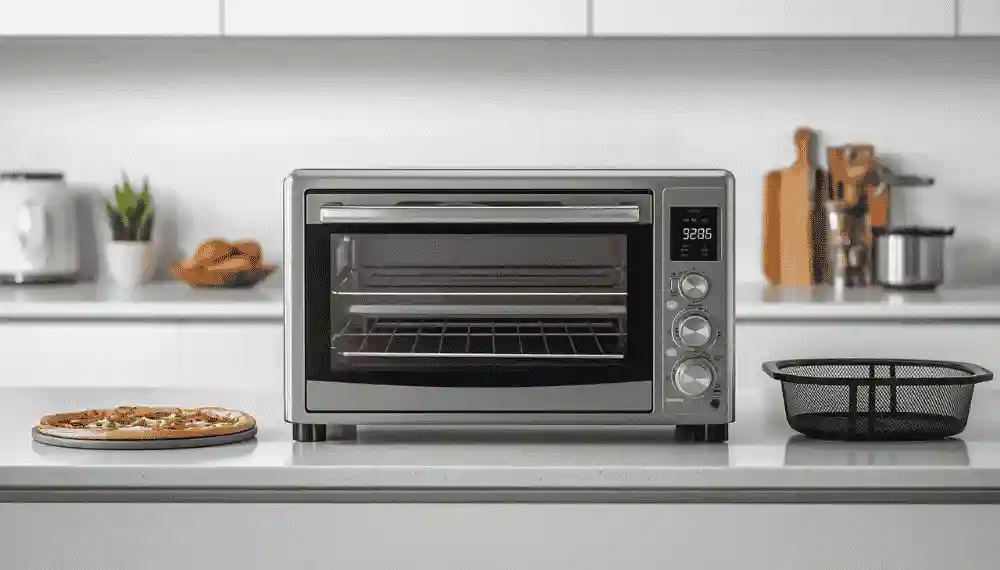
Out of the box, the Breville includes a 13-inch nonstick pizza pan, two oven racks, a 9×13 enamel roasting pan, a mesh air fry basket, and a broiling rack — five separate accessories, which is more than most competitors in this price range include as standard. Everything arrives individually wrapped in protective foam, and the unit itself is wrapped separately, reflecting Breville's general build quality across its product line.
The honest first impression is weight. At roughly 25 pounds before you've added any accessories, lifting the BOV900BSS out of its shipping box and onto a counter is a noticeably heavier task than unboxing most toaster ovens, and if you're doing this alone, clearing a path and having the final counter spot ready before lifting is worth the extra minute of preparation. Once it's in place, it's not something you'll be moving regularly, which matters for the placement decision covered below.
Initial setup is straightforward: plug in, and the LCD display walks through a brief initial calibration. Unlike some smart-display ovens, there's no app pairing or account setup required to use core functions — every cooking mode works immediately without any software setup, which is a genuine point in its favor for anyone who wants to start cooking without an onboarding process.
How the Element IQ System Actually Works
Short answer: six independent quartz heating elements are individually monitored and powered, so the oven can shift more or less heat to specific zones depending on what you're cooking, rather than running every element at a fixed, uniform output.
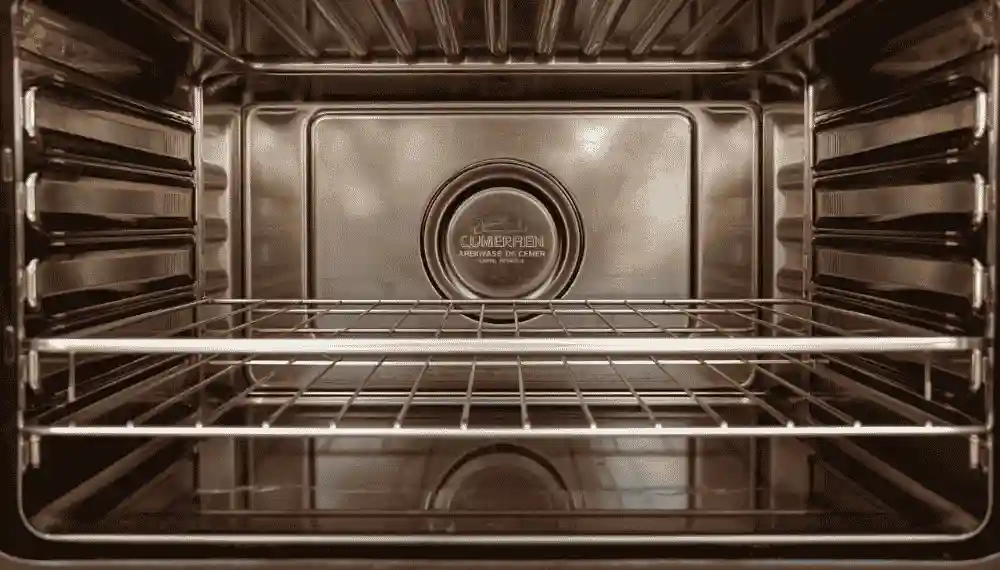
This is the feature our roundup testing named as the reason for the Breville's top result, but it's worth understanding the actual mechanism rather than just the marketing term. Most toaster ovens run their heating elements as a simple on/off pair — top elements and bottom elements, cycling together to maintain a set temperature. The Element IQ system instead treats six separate quartz elements as individually addressable, using internal sensors to detect what type of cooking mode is active and adjusting power distribution across those six elements accordingly.
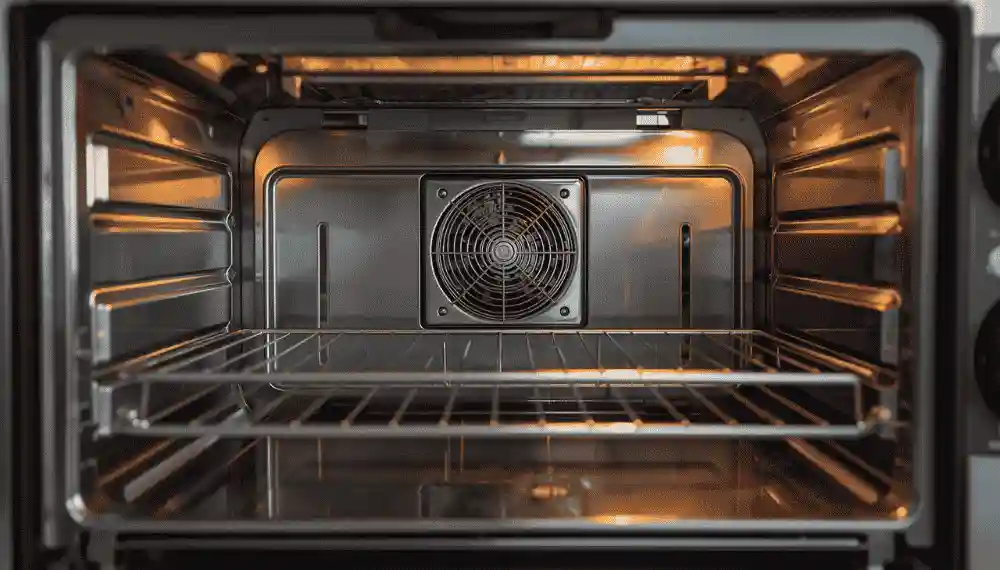
In practice, this means the oven behaves differently depending on the task in a way a simpler heating system can't replicate. When toasting, it concentrates more power toward elements positioned for fast, even surface browning. When baking, it shifts toward steadier, more uniform heat distribution across the whole cavity to avoid the hot-spot problem that plagues simpler toaster ovens. When air frying, additional power routes to elements positioned to maximize the benefit of the super convection fan's airflow pattern.
The real-world result we measured directly: a full tray of a dozen sugar cookies came out evenly golden, edge to edge, with no rotation needed mid-bake — a result that simpler heating systems in lower-priced competitors couldn't match without manual intervention.

Living With It: What the First Month Actually Looks Like
Short answer: daily use is straightforward and intuitive once you've learned the preset functions, but the learning curve on the digital display is real for anyone used to simple dial controls, and the audible fan on high convection settings takes some adjustment.
The thirteen preset cooking functions cover genuinely distinct use cases rather than feeling redundant — toast, bagel, broil, bake, roast, warm, pizza, proof, air fry, reheat, cookies, slow cook, and dehydrate each adjust both temperature defaults and the Element IQ power distribution behind the scenes. For someone moving from a basic dial-controlled toaster oven, the first week involves some genuine learning: which preset to choose for a given dish isn't always obvious from the label alone, and a few early cooks benefit from checking the included guide rather than guessing.
Once past that initial learning period, daily use becomes routine quickly. The LCD display clearly shows a preheat countdown and notifies you with a tone when the target temperature is reached, which removes the guesswork that plagues ovens without any preheat confirmation.
The fan noise on the super convection setting is genuinely audible — noticeably more so than the standard bake setting, and worth knowing about if your kitchen is open to a living or working space where noise carries. It's not disruptive, but it's not silent either, and anyone particularly sensitive to appliance noise should factor this in before buying.
What's Actually Included, and Do You Need All of It?
Short answer: yes, realistically — unlike some toaster ovens that ship with accessories you'll rarely touch, all five included pieces here cover genuinely distinct, regularly-used functions rather than padding the box for marketing purposes.
It's worth a closer look at what comes included, since accessory quality and usefulness varies enormously across toaster ovens at every price point.
The 13-inch nonstick pizza pan is sized specifically to take advantage of the oven's maximum pizza capacity, and the nonstick coating means it wipes clean easily after cheese inevitably bubbles over the edge.
Two oven racks allow genuine two-position cooking — using one position for general baking and shifting to the top rack for a quick browning finish, the same two-phase cooking method that improves results across almost any toaster oven, made easier here by having a spare rack on hand rather than needing to swap mid-cook.
The 9×13 enamel roasting pan is full-size, matching a standard casserole dish, and is the accessory most responsible for the oven's ability to genuinely handle family-size roasting and baking rather than just toaster-oven-scale portions.
The mesh air fry basket is what makes the air fry preset function as true air frying rather than just
high-heat convection baking — it elevates food and maximizes airflow contact in a way a flat tray cannot replicate.
The broiling rack sits at a height calibrated for the broil preset's heat intensity, positioning food close enough to the top elements for genuine browning and char without the guesswork of estimating rack height yourself.
In practice, after several months of regular use, all five pieces stay in active rotation rather than sitting unused in a cabinet, which isn't true of every toaster oven's included accessory set.
Cost Per Use: Does the Price Make Sense Over Time?
Short answer: if you use it several times a week for years, the per-use cost drops to a genuinely reasonable level — but that math only works out if the oven actually gets used that often, which circles back to whether your cooking habits justify the upfront price.
A different way to evaluate the $350–$400 price tag, beyond comparing it feature-for-feature against cheaper models, is to think in terms of cost per use rather than upfront cost alone. Toaster ovens in this build quality tier are designed for a 5 to 8 year typical lifespan with regular care. If a household uses this oven 4 to 5 times a week, every week, for that full lifespan, the per-use cost works out to a small fraction of a dollar — genuinely negligible against the value of consistent, even cooking results and the convenience of not needing a separate air fryer or relying on a full-size oven for smaller meals.
The math changes considerably for occasional use. A toaster oven used once or twice a week, primarily for simple tasks, extends the break-even timeline considerably and makes the price premium over a
mid-range model harder to justify purely on a cost basis, even though the oven itself would perform just as well regardless of how often it's used.
This is really the same underlying question as the "who should buy this" sections elsewhere in this review, just framed financially rather than functionally: frequent, demanding use makes the price make sense. Occasional, simple use doesn't change the oven's quality, but it does change whether paying for that quality is the most rational use of the budget.
Short answer: most reported issues center on crumb tray access, occasional inconsistent air fry results in overcrowded baskets, and confusion over which preset to use for specific dishes — all addressable without a service call.

A handful of questions and minor frustrations come up consistently enough among owners that they're worth addressing directly, since most have straightforward fixes rather than indicating a defective unit.
Crumb tray access requires sliding the unit slightly. Unlike some competitors with a fully external, easily removable crumb tray, the BOV900BSS's tray access is positioned in a way that benefits from pulling the unit a few inches forward on the counter before removing it. Once you've done this once, it becomes a quick habit, but it catches first-time owners off guard.
Air fry results can disappoint if the basket is overcrowded. This isn't unique to the Breville, but it's worth restating clearly: the mesh air fry basket needs a single layer with visible space between pieces to achieve the crispy results the model is known for. Piling food into the basket traps steam and produces soft, unevenly cooked results that owners sometimes mistakenly attribute to the appliance underperforming rather than to overcrowding.
Choosing the wrong preset for a dish. The "Roast" and "Bake" presets, in particular, are easy to confuse, since both use moderate-to-high heat with convection. Roast is calibrated for larger cuts of meat and vegetables, applying slightly more aggressive heat distribution suited to browning exteriors; Bake is calibrated for more even, gentler heat suited to baked goods and casseroles. Using Roast for delicate baked goods can result in over-browning before the interior finishes cooking.
Stainless steel exterior shows fingerprints. A cosmetic rather than functional issue, but one several owners mention. A microfiber cloth and a stainless-steel-specific cleaner handle this quickly, and it doesn't affect performance in any way.
Breville BOV900BSS vs. Its Predecessor: Is the Upgrade Worth It If You Already Own an Older Smart Oven?
Short answer: if you own an earlier Breville Smart Oven without Element IQ or with a single-speed convection fan, the upgrade is meaningful specifically for baking evenness and air fry performance — but if your current unit still works well and you don't bake often, the improvement may not justify the cost of replacing a functioning appliance.
Breville has iterated on its Smart Oven line over several product generations, and the most relevant upgrades in the current BOV900BSS relative to earlier non-Pro Smart Oven models are the six-element Element IQ system (versus simpler heating element configurations in older models) and the two-speed super convection fan (versus single-speed convection in earlier generations). The practical difference shows up most clearly in baking evenness and air fry crispness — both areas where the additional control over heat distribution genuinely changes the result, not just the marketing copy.
If you're currently using an older toaster oven, convection or not, and frequently dealing with uneven baking results or have been wanting genuine air fry capability without a separate appliance, the upgrade case is straightforward. If you already own a newer mid-range convection toaster oven that handles your actual cooking needs well, the BOV900BSS's improvements are real but may represent diminishing returns relative to the price difference, particularly if baking isn't a frequent activity in your kitchen.
Who Should NOT Buy This Toaster Oven
Short answer: anyone with limited counter space, anyone whose toaster oven use is mostly toast and basic reheating, and anyone on a budget under $200 who would be better served by a mid-range model that covers 80% of the same ground at half the price.
This is the section a roundup format rarely has room to develop fully, and it matters as much as the praise above.
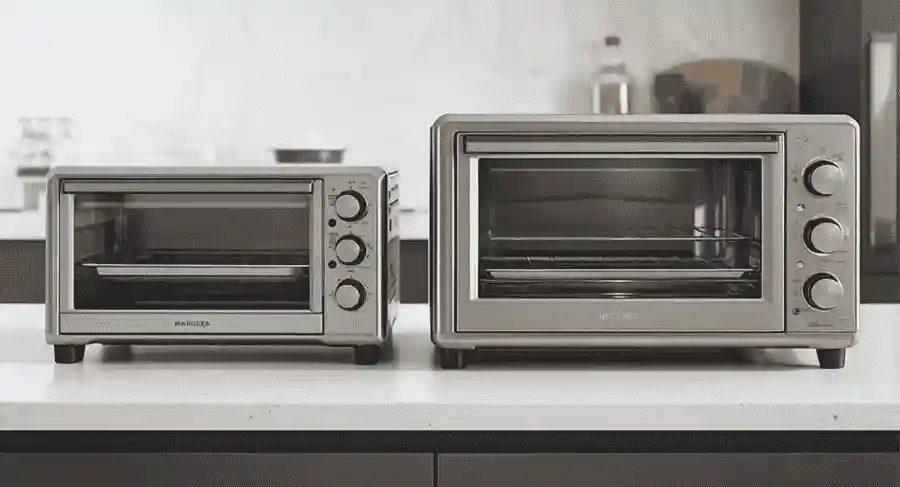
Skip this if counter space is genuinely limited. At 21.5 × 16 × 12.5 inches and roughly 25 pounds, this is one of the largest, heaviest toaster ovens on the market. If you've read our guide on sizing a toaster oven to your actual space and landed on "small" or "mid-size" as your real answer, the BOV900BSS is the wrong direction regardless of its performance ranking.
Skip this if your cooking is mostly toast and reheating. The Element IQ system and super convection fan are solving problems — uneven baking, mediocre air frying — that simply don't arise if your toaster oven use rarely goes beyond toast, bagels, and reheating leftovers. A simpler, cheaper model handles those tasks just as well, and you'd be paying a significant premium for capability you won't use.
Skip this if $400 is a stretch and you cook fairly simply. The Cuisinart TOA-70, at roughly $160–200, delivers genuinely strong everyday performance — solid baking, reliable air frying, easy controls — at less than half the Breville's price. The gap between the two models is real, but it's a gap that matters most to people who push their toaster oven hard and often. Occasional or moderate users may not notice it enough to justify the difference.
Skip this if you're sensitive to appliance noise and plan to use the oven in an open-concept space or apartment with thin walls, given the audible fan on higher convection settings.
Frequently Asked Questions
Is the Breville Smart Oven Air Fryer Pro worth it? For households that bake regularly, want genuine air fry results without a separate appliance, and have the counter space and budget for it, yes — it delivered the most consistent, even cooking results of any model in our full testing roundup. For occasional users whose cooking leans toward toast and simple reheating, a mid-range model delivers most of the practical benefit at a meaningfully lower price.
Breville BOV900BSS vs BOV845BSS — what's the real difference? The BOV900BSS (this model, the "Pro" tier) includes the full six-element Element IQ system and a two-speed super convection fan, while earlier and lower-tier Smart Oven models in Breville's lineup generally use simpler heating element configurations and single-speed convection. The practical difference shows up most in baking evenness and air fry performance; basic toasting and reheating performance is more comparable across the lineup.
How do you clean the Element IQ heating elements? The quartz elements themselves should not be scrubbed or have liquid cleaners applied directly, the same general rule that applies to heating elements in any toaster oven. Residue typically burns off during normal use; for serious buildup concerns, a light, dry brush pass with no pressure is the safer approach, and checking the included manual for
model-specific guidance is worth doing before assuming a general cleaning method applies.
What's the Breville toaster oven warranty claim process? The BOV900BSS includes a 2-year limited warranty. For a claim, Breville generally requires proof of purchase and a description of the issue, processed either through their customer service line or registered retailer, depending on where the unit was purchased. Keeping the original receipt and registering the product shortly after purchase, where Breville offers registration, simplifies this process if it's ever needed.
Does the Breville Smart Oven Air Fryer Pro replace a standalone air fryer? For most users, yes — its air fry performance in our testing was the strongest of any toaster oven we evaluated, producing genuinely crispy results comparable to dedicated basket-style air fryers. The one caveat, covered in more depth in our toaster oven vs air fryer comparison, is that a dedicated basket air fryer's tighter, more contained airflow still has a slight edge on small-batch crispness, even against the Breville's strong convection performance.
Can you buy replacement accessories separately if one gets damaged? Yes, Breville sells replacement pans, racks, and the air fry basket through its official parts channels and major retailers, so a damaged or worn accessory doesn't require replacing the entire unit. Using the exact model number when searching for replacement parts ensures compatibility, since accessory dimensions can vary slightly between different Smart Oven generations.
The Bottom Line
The Breville Smart Oven Air Fryer Pro earns its top spot in our broader roundup honestly — the Element IQ system and super convection fan solve real, common toaster oven frustrations, particularly around baking evenness and air fry performance. Whether it's worth $400 specifically depends on how hard you'll actually push it: frequent bakers and air fry users with the counter space and budget will get real, measurable value out of every one of its advantages. Occasional or simple-cooking households are better served by a mid-range model that covers most of the same ground for significantly less.
What to Read Next
To see how the Breville stacked up against six other tested models directly, including the Ninja Foodi DT201 and several mid-range and budget alternatives, see our Best Toaster Ovens of 2026 roundup. Once you've decided on a model, our Toaster Oven Temperature Guide helps you dial in the right settings once it's on your counter. And if convection and air fry capability are the features driving your decision, Convection Toaster Oven vs Regular: Is the Upgrade Worth It? covers why its two-speed convection fan matters more than the wattage number alone.
Zahid Hussain is a kitchen appliance reviewer and home cook. He has tested more than 20 countertop appliances for ProvenPathly, with a focus on toaster ovens, air fryers, and countertop convection ovens. His testing methodology prioritizes real-world home cooking over lab conditions — every recommendation is made from a kitchen counter, not a spec sheet.