
By Zahid Hussain | Kitchen appliance reviewer & home cook
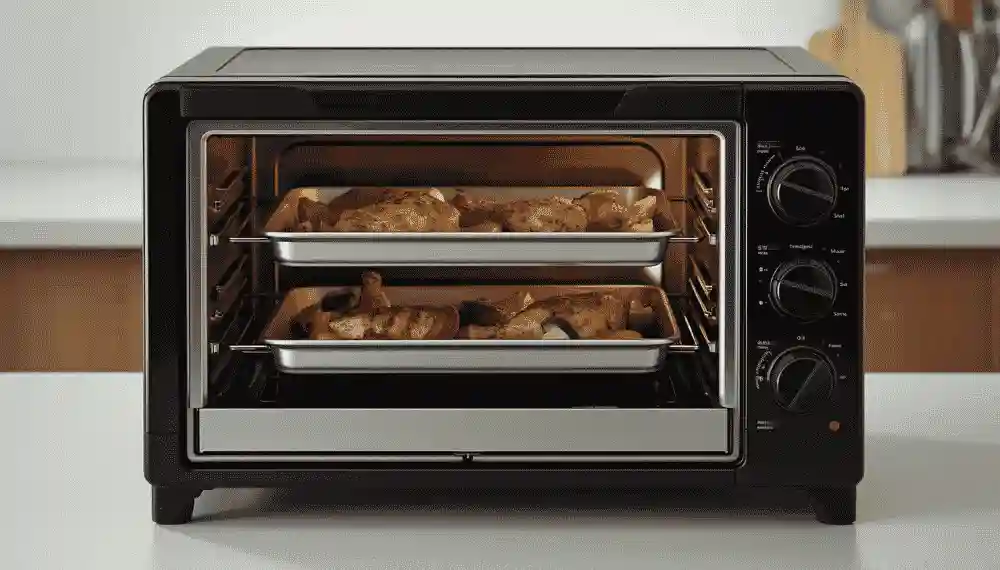
In our full toaster oven testing, the Ninja Foodi DT201 stood out for one specific reason that no other model in the roundup could match: it cooks on two completely independent levels at once, with full convection circulation reaching both, rather than just stacking two racks inside a single shared heating zone. For a household of four or more cooking a real dinner rather than a single portion, that one feature changes more about the actual cooking experience than almost any other spec on the page.
This review goes beyond the roundup verdict to answer the question that actually matters for families considering this specific model: what does feeding a family with this oven look like night after night, where does its substantial size become a real problem rather than just a number, and who should look elsewhere despite its strong test results.
How True Surround Convection Actually Works
Short answer: Ninja's True Surround Convection delivers hot air from the front, back, top, and bottom of the cavity simultaneously, rather than relying on a single fan positioned at one end, which is what allows genuinely even cooking across two separate rack levels at once.
Most convection toaster ovens position a single fan at the back or top of the cavity, circulating air that has to travel the full length of the oven to reach food at the opposite end — a setup that works reasonably well for a single rack but tends to create more noticeable unevenness when two racks are loaded simultaneously, since the airflow has to do more work to reach every surface.
The Ninja DT201's True Surround Convection system instead routes airflow from multiple directions around the cavity, which is the specific engineering choice that makes genuinely simultaneous two-level cooking viable rather than just technically possible. Ninja's own specifications describe this as delivering airflow with significantly more power than a standard single-fan convection oven, and in our direct testing, this showed up clearly: cooking chicken thighs on the top level and a sheet pan of broccoli on the bottom level at the same time, both came out properly cooked together, with only minor variation between the two levels rather than one rack lagging noticeably behind the other.
This matters specifically for family cooking because it solves the actual problem that pushes most households back toward batch cooking or the full-size oven: getting a protein and a side dish, or two different dishes entirely, ready at the same moment without rotating racks partway through or accepting that one will finish later than the other.
A Real Family Dinner, Mapped Across Both Racks
Short answer: the two-level design genuinely changes weeknight meal planning, letting you build a complete dinner across both racks simultaneously rather than treating the oven as a single-task appliance.
Beyond the single chicken-and-broccoli example from our initial roundup testing, it's worth walking through what a fuller weeknight actually looks like using both levels intentionally.
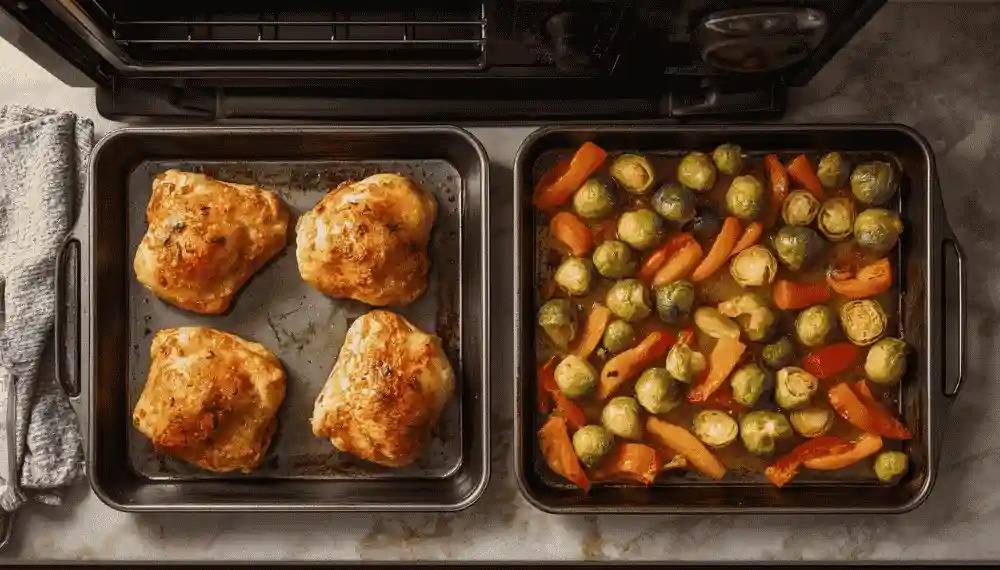
A complete sheet-pan-style dinner for four: bottom level holds a tray of bone-in chicken thighs at 400°F, top level holds a tray of halved Brussels sprouts and sliced bell peppers. Both finish within a few minutes of each other, since the True Surround system reaches both levels with comparable intensity, and unlike a single-level oven, there's no need to remove one tray to make room for the other partway through.
Baking and reheating at once: top level holds a tray of dinner rolls warming through, bottom level reheats leftover lasagna from the night before, each at its own appropriate setting if your model's dual-zone temperature control allows it, or at a shared moderate temperature that works reasonably well for both if running a single temperature setting.
A larger family gathering: with the air roast and whole roast presets, a 5-pound batch of chicken pieces on one level alongside a second tray of roasted root vegetables on the other genuinely replaces what would otherwise require either two separate cooking sessions in a single-level oven or pulling out the full-size oven entirely.
The practical theme across all three examples: the two-level design's real value isn't just "more capacity," it's the elimination of sequencing. Families cooking for four or more in a single-level toaster oven are constantly choosing what cooks first and what waits; the DT201 mostly removes that decision.
Preheat Speed: Why 90 Seconds Matters More Than It Sounds
Short answer: a 90-second preheat to 350°F isn't just a minor convenience number — for weeknight family cooking, it meaningfully changes how late you can start dinner and still get everyone fed on a normal schedule.
In our testing, the DT201 reached 350°F on air roast mode in 92 seconds from a cold start, two to three times faster than several other models in our broader roundup. This isn't a number that matters much in isolation, but it compounds meaningfully across a household actually cooking dinner on a real schedule.
For a family deciding what's for dinner at 5:45 with hungry kids and limited patience, the difference between an oven that's ready to cook in 90 seconds versus one that needs 6 to 8 minutes of preheating is the difference between starting immediately and building in a real, noticeable delay before cooking even begins. Over the course of a week of regular weeknight cooking, this adds up to meaningful time, not just a marginal convenience.
This speed advantage is also what makes the two-level cooking genuinely practical rather than theoretically appealing. A fast preheat combined with simultaneous two-level cooking means a complete dinner, protein and side together, can realistically go from "deciding what to cook" to "on the table" faster than many people expect from an appliance this size.

The Size Reality: Where the Footprint Becomes a Real Problem
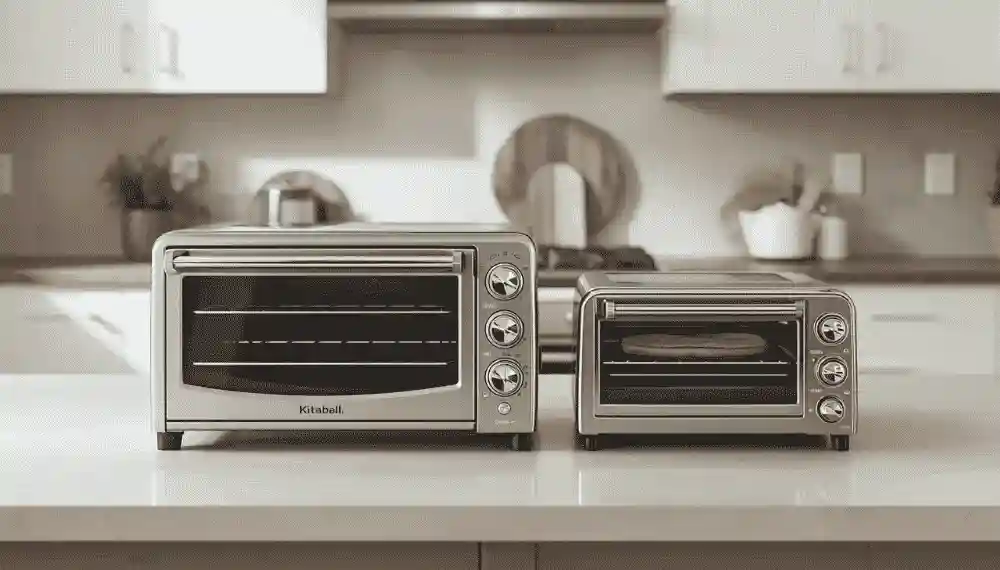
Short answer: this is the largest toaster oven in our full roundup by a meaningful margin, closer to a small microwave's footprint than a traditional toaster oven, and it should be ruled out immediately if counter space is even moderately tight.
This needs to be stated plainly rather than softened, because it's the single biggest tradeoff of this specific model. The DT201's exterior dimensions put it in a different size category entirely from most of the toaster ovens covered elsewhere on this site — closer to a small built-in microwave than a typical countertop toaster oven.
In practical terms, this means: it needs a genuinely dedicated, permanent spot on the counter, not a flexible one that shares space with other appliances on rotation. It's heavy enough that moving it isn't a casual decision. And if you're working with a small or apartment-style kitchen, this model is very likely the wrong size category entirely, regardless of how appealing the two-level cooking sounds on paper.
Before buying specifically for the two-level capability, it's worth measuring your actual available counter space against the unit's listed exterior dimensions with real tape-measure precision, not an estimate. A common and expensive mistake is ordering based on the appeal of the feature set without confirming the physical footprint will actually work in the kitchen it's meant for.
Unboxing and First Setup: What to Expect
Short answer: this is a genuinely large, heavy appliance to unbox and place, and first-time setup involves more initial decision-making than a standard single-level oven simply because there's a second rack system and dual-zone controls to understand.
Given its XL classification, the DT201 arrives in a substantially larger shipping box than most toaster ovens, and at this size and weight, having a clear, pre-measured counter spot ready before unboxing avoids the common frustration of lifting a large, heavy appliance only to discover it doesn't quite fit where you'd planned. Two-person lifting is a reasonable approach for anyone not confident managing the weight alone.
Once placed, initial setup involves familiarizing yourself with how the two rack levels and their associated controls interact. Unlike a single-level oven where there's one set of settings to learn, the DT201's appeal and complexity both stem from managing two zones at once. The included manual walks through which presets support genuine dual-zone independent control versus which apply a shared setting across both levels, and it's worth a careful first read rather than assuming every preset behaves identically to a simpler single-level oven you may have used previously.
The cooking levels themselves don't require rotation or repositioning the way single-level ovens sometimes do mid-cook — once trays are loaded on both levels, the True Surround Convection system handles distribution without needing manual intervention, which is a meaningful simplification once you're past the initial learning curve.
Troubleshooting Common Ninja Foodi DT201 Issues
Short answer: most reported issues involve uneven results between the two levels in specific preset modes, fan noise complaints, and confusion over which accessories pair with which cooking level — all addressable without assuming the unit is defective.
A few recurring questions and minor frustrations come up often enough to address directly.
Slight unevenness between top and bottom levels in certain modes. While True Surround Convection significantly reduces the gap between levels compared to single-fan designs, our testing did note the top rack finishing very slightly faster in some bake tests. For dishes sensitive to exact timing, checking both levels a few minutes before the estimated finish time, rather than assuming both are perfectly synchronized, avoids any surprise.
Fan noise during air fry and air roast modes. This isn't a malfunction — it's a function of how aggressively the system needs to move air to maintain even heat across a larger, two-level cavity. It's
genuinely louder than smaller single-level convection ovens, and it's worth setting expectations accordingly rather than assuming something is wrong with the unit.
Confusion over accessory placement for two-level cooking. Some owners initially aren't sure whether specific included accessories are meant for the top or bottom level, or whether they're interchangeable. Most accessories are interchangeable between levels, with the manual specifying any exceptions for particular cooking modes like whole roast, where rack positioning relative to the heating elements matters more.
Stainless steel exterior fingerprints and smudging. As with most stainless steel appliances, this is cosmetic only. A larger exterior surface area means more visible area for smudging to show up, but it wipes clean easily with a standard stainless steel cleaner and microfiber cloth.
Short answer: the larger interior and two-level design mean more total surface area to clean, and the process takes meaningfully longer than maintaining a smaller single-level model, though the core cleaning method stays the same.
The general cleaning approach covered in our toaster oven cleaning guide applies here, but it's worth being upfront that a larger, two-level interior simply has more surface area collecting grease and crumbs than a standard single-rack model, and cooking two dishes simultaneously, as the DT201 is designed for, means twice the potential mess in a single session compared to a single-tray cook.
In practice, this means crumb tray emptying and a quick interior wipe-down need to happen slightly more often than with a smaller model to avoid buildup, simply because more food is moving through the cavity in any given week of regular family use. The stainless steel exterior also shows fingerprints readily, which with a larger surface area to begin with means more visible smudging over time without regular wiping.
Is the Price Justified for a Family That Cooks Real Meals Often?
Short answer: for families cooking full meals most nights of the week, the per-use value is strong, since the time saved through simultaneous two-level cooking adds up meaningfully over months and years of regular use, even though the upfront price sits above most single-level toaster ovens.
At roughly $230 to $270, the DT201 sits in a genuinely reasonable middle ground — more expensive than entry-level and most mid-range single-level toaster ovens, but meaningfully less than the premium Breville despite offering more raw capacity. For a family using it most nights to cook a real,
multi-component dinner, the time saved by not sequencing dishes across a single level adds up to real, recurring value rather than a one-time convenience.
For occasional users, or households that rarely cook more than one dish at a time, the calculus shifts. The premium over a smaller single-level model is harder to justify if the defining two-level feature rarely gets used as intended, which circles back to the household-size guidance above: this is a price that makes the most sense for the specific use case it was built for, not a universal best value for every kitchen.
Who Should NOT Buy This Toaster Oven
Short answer: small households, anyone with genuinely limited counter space, and anyone particularly sensitive to appliance noise should look elsewhere, regardless of how strong its family-cooking performance is.
Skip this if your household is one or two people. The entire value proposition of two-level simultaneous cooking depends on regularly needing that much capacity at once. A smaller household will rarely fill even one level to capacity, let alone benefit from running two simultaneously, making this oven's defining feature mostly unused overhead.
Skip this if counter space is even moderately tight. As covered above, this is the largest model in our full roundup, and no amount of cooking performance compensates for an appliance that simply doesn't fit the available space, or that crowds out other counter functions you need daily.
Skip this if noise sensitivity is a real concern. The fan is genuinely loud in air fry and air roast modes — among the louder models we tested — which matters more in open-concept living situations or households where a quiet kitchen environment is a priority during or after cooking.
Skip this if interior cleaning effort is a deciding factor. The larger, more involved cleaning process relative to smaller single-level models is a real, ongoing time cost, not a one-time consideration, and it's worth weighing against the cooking capability gained.
Ninja DT201 vs. Breville BOV900BSS: Which Family-Size Pick Is Right for You?
Short answer: choose the Ninja if simultaneous two-level cooking and the fastest possible preheat matter most; choose the Breville if single-level baking evenness and air fry crispness matter more than raw capacity.
Both models top our broader roundup for different reasons, and families specifically choosing between them should focus on which problem they're actually trying to solve. The Ninja's defining advantage is genuine simultaneous two-level cooking with the fastest preheat in our test group — the right fit for families regularly cooking complete multi-component meals who want speed and capacity above all else.
The Breville, by contrast, wins on baking evenness and air fry quality within a single, somewhat smaller cooking level, making it the better fit for families who bake often or prioritize air fry results over the convenience of cooking two dishes simultaneously. Neither is a wrong choice for a family kitchen; they're solving genuinely different problems, and the right pick depends on which of those two problems shows up more often at your specific dinner table.
Frequently Asked Questions
Is the Ninja Foodi DT201 worth it for a family of 4? Yes, specifically because of its two-level simultaneous cooking and fast preheat, which together solve the sequencing problem that most single-level toaster ovens create for families cooking a complete meal at once. The tradeoff is its substantial size, which requires genuinely adequate, dedicated counter space to be a practical fit.
Ninja DT201 vs Breville BOV900BSS — which should a family choose? It depends on priorities: the Ninja wins on simultaneous multi-dish cooking capacity and preheat speed, while the Breville wins on
single-level baking evenness and air fry crispness. Families who regularly cook complete meals with multiple components benefit more from the Ninja's two-level design; families who bake frequently or prioritize air fry quality may get more value from the Breville.
Does the Ninja Foodi DT201 fit a 12 lb turkey? Yes, the unit's XL interior is rated to fit a whole roast in the 12-pound range, in addition to two 12-inch pizzas, making it genuinely capable of handling larger single-item cooking in addition to its two-level simultaneous capability.
What are the best two-level cooking tips for the Ninja Foodi DT201? Pair dishes with similar cook times and temperatures when possible to avoid one rack finishing significantly before the other. For dishes with different ideal temperatures, choosing a moderate middle-ground setting that works reasonably well for both, or accepting a few extra minutes on the more sensitive dish, generally produces better results than constantly adjusting mid-cook.
Is the Ninja Foodi DT201 too loud for an open-concept kitchen? It's on the louder end of the toaster ovens we've tested, particularly on air fry and air roast settings, and this is worth factoring in if your kitchen is open to a living or dining space where conversation or media noise would compete with the fan during cooking.
The Bottom Line
The Ninja Foodi DT201 solves a specific, real problem better than any other toaster oven in our full roundup: getting a complete, multi-component family meal cooked simultaneously rather than sequentially. For households of four or more who regularly cook real dinners rather than individual portions, that's a genuine, repeated, weeknight advantage. For smaller households or kitchens with real space constraints, its substantial footprint and noise level are tradeoffs significant enough to look toward a more moderately sized model instead, regardless of how well this one performs on paper.
What to Read Next
To see how the Ninja compared against six other tested models, including the Breville BOV900BSS and several mid-range alternatives, see our Best Toaster Ovens of 2026 roundup, compared against six other ovens in our full testing roundup. If an XL footprint sounds like too much for your kitchen, here's how to size correctly first in our Small Toaster Oven vs Large guide. And for more meal ideas that take advantage of a toaster oven's full capacity, our 25 Meals You Can Actually Cook in a Toaster Oven includes two-rack meal ideas that take advantage of simultaneous cooking.
Zahid Hussain is a kitchen appliance reviewer and home cook. He has tested more than 20 countertop appliances for ProvenPathly, with a focus on toaster ovens, air fryers, and countertop convection ovens. His testing methodology prioritizes real-world home cooking over lab conditions — every recommendation is made from a kitchen counter, not a spec sheet.