By Zahid Hussain | Kitchen appliance reviewer & home cook
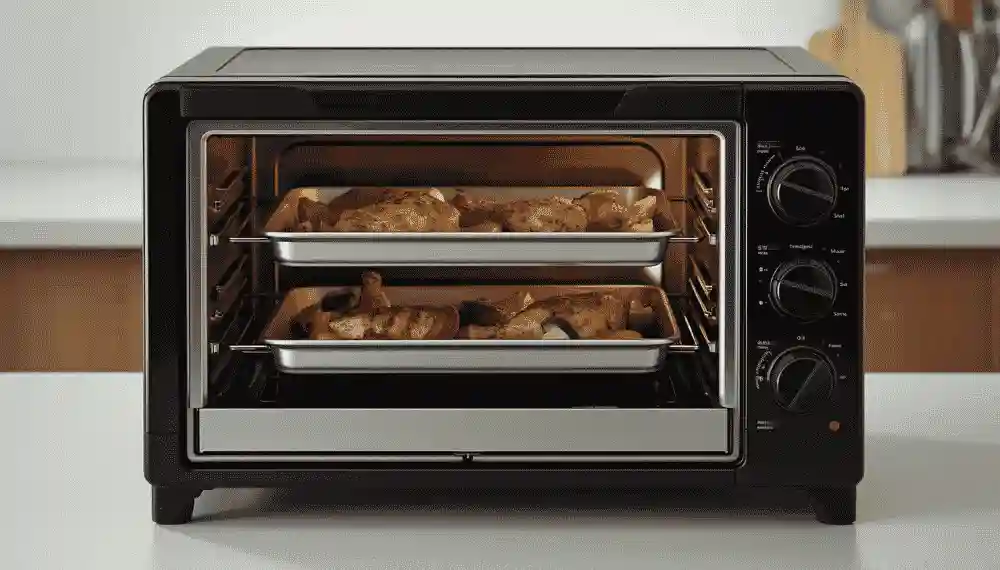
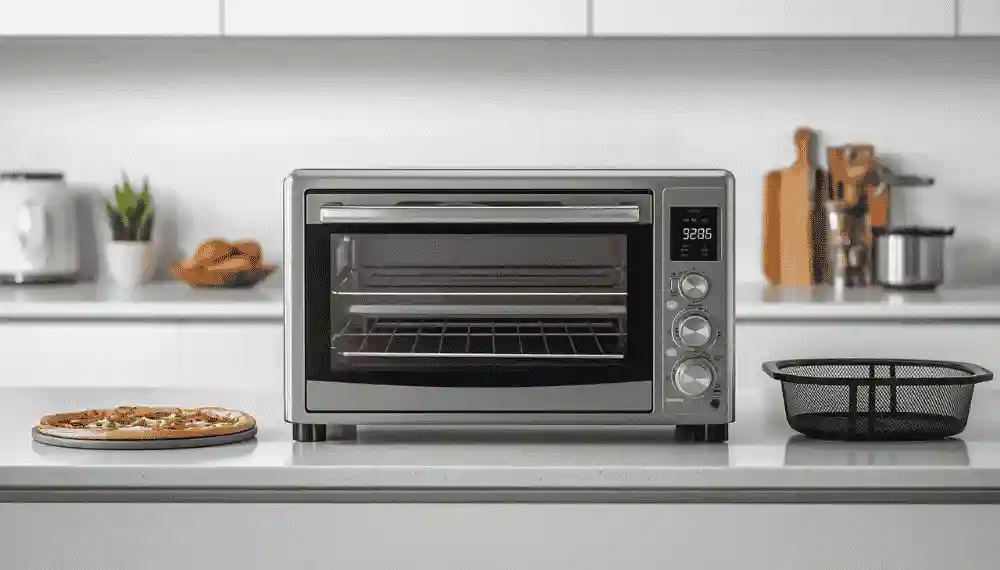
When deciding between a convection toaster oven vs regular model, every toaster oven sold today falls into one of two camps: it has a fan that circulates hot air, or it doesn't. That single difference — one small motor and a few plastic blades — is usually responsible for a $30 to $100 price gap between otherwise similar-looking models, and it's the single most common "should I pay more" question I get asked about toaster ovens.
I've tested both types side by side, cooking identical meals on identical days, and the honest answer isn't a flat yes or no. It depends heavily on what you actually cook most often. This guide walks through exactly where convection earns its premium, where it doesn't, and how to figure out which category you fall into before you spend the extra money.
What Does Convection Actually Mean in a Toaster Oven?
Short answer: convection means a built-in fan circulates hot air around the food instead of letting heat sit still inside the cavity, and that moving air is what makes food cook faster and brown more evenly.
A regular, non-convection toaster oven heats food the way the earliest ovens always have: radiant heat from exposed coils above and below the food warms the air inside the cavity, and that warm air eventually transfers heat to whatever's cooking. The air itself isn't moving much — it just sits there, getting hot, with the areas closest to the elements naturally running warmer than the center of the cavity.
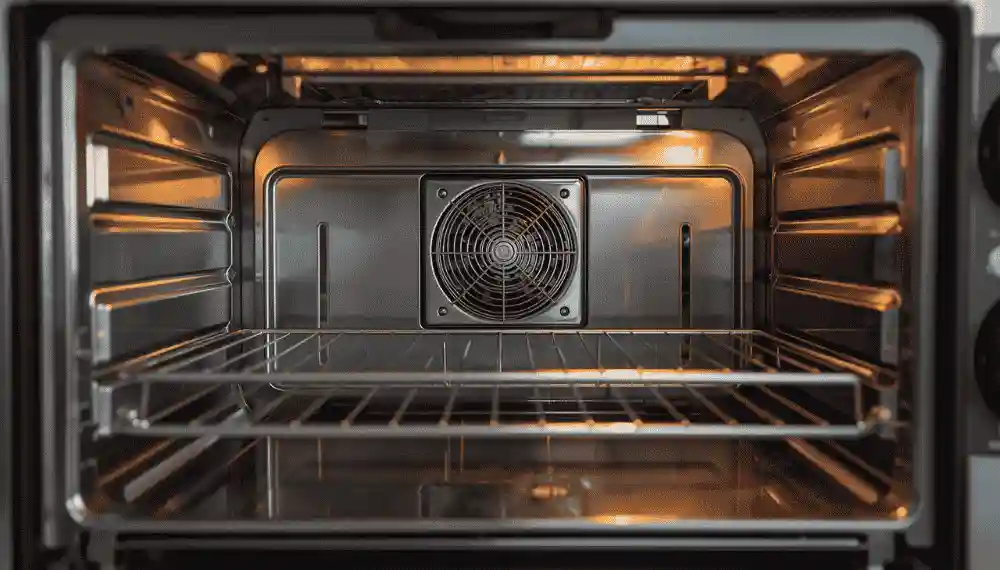
A convection toaster oven adds a small fan, usually mounted at the back or top of the cavity, that continuously pushes that same heated air around the food. Moving air transfers heat to a surface significantly faster than still air does, which is why convection ovens cook faster and brown more evenly — every surface of the food is getting hit by actively circulating hot air rather than waiting for warmth to slowly radiate and settle.
This is mechanically the same principle that makes an air fryer work, just at a gentler intensity and inside a larger cavity. A convection toaster oven is, in a real sense, a milder version of an air fryer that can also bake a casserole — which is exactly why so many modern "convection toaster ovens" market themselves as having an air fry setting, even though the underlying fan is doing similar work either way.
How Much More Does a Convection Toaster Oven Actually Cost?
Short answer: typically $30 to $100 more than a comparable non-convection model, though the gap narrows or disappears entirely once you're shopping above $150.
At the budget end of the market, the price difference is the most visible. A solid non-convection toaster oven — something built mainly for toast, basic baking, and reheating — can be found in the $50 to $90 range. Adding a convection fan to a similarly sized unit typically pushes the price into the $100 to $150 range for a comparable build quality.
Once you move into mid-range and premium toaster ovens, almost every model includes convection as standard, and the price differences between models come down to other features entirely — number of
cooking presets, air fry basket quality, interior capacity, digital displays versus dials. At this tier, asking "is convection worth the upgrade" stops being the relevant question, since you'd have to actively search for a non-convection model to avoid it.
The practical takeaway: the "is convection worth it" question matters most at the entry-level price tier, where you're choosing between a genuinely no-frills model and a genuinely fan-equipped one. Above roughly $150, convection has effectively become the default, and the decision shifts to other features.
Does Convection Actually Cook Food Faster?
Short answer: yes, typically 20 to 25 percent faster than the same recipe in a non-convection toaster oven, which is consistent enough that most manufacturers build it into their official cooking instructions.
In side-by-side testing, this is one of the more reliable, repeatable differences between the two oven types. A tray of frozen french fries that takes 22 minutes in a non-convection toaster oven typically finishes in 16 to 18 minutes with convection running, at the same temperature. Roasted vegetables show a similar gap, often finishing 3 to 5 minutes earlier with noticeably better browning on the edges.
This is also why the standard advice for converting a conventional oven recipe to convection involves either lowering the temperature by an additional 25°F on top of the usual toaster oven adjustment, or shortening the cook time by roughly 20%, rather than doing both at once. The food is genuinely cooking faster because moving air is transferring heat more efficiently, not because the oven is simply running hotter.
Where this speed advantage matters most in practice: weeknight cooking, where shaving five minutes off a side dish or finishing dinner before everyone's patience runs out is a real, repeated benefit rather than a one-time convenience.
Does Convection Actually Brown Food More Evenly?
Short answer: yes, and this is arguably the more valuable benefit of the two, since it solves the single most common complaint about toaster oven baking — uneven hot spots.
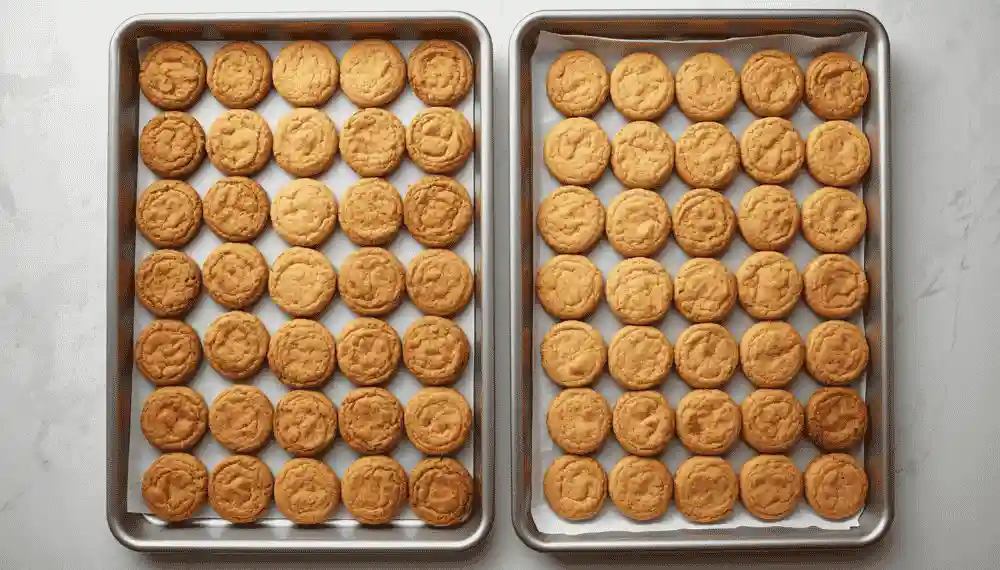
Every toaster oven, convection or not, has some degree of hot spot, usually toward the back of the cavity closest to the heating elements. In a non-convection model, this unevenness shows up clearly: cookies on a tray often need to be rotated halfway through baking, or the back row will be noticeably darker than the front by the time the front row is properly done.
A convection fan actively works against this by continuously redistributing hot air throughout the cavity rather than letting it settle into uneven pockets. In direct testing, a batch of a dozen sugar cookies baked without convection showed a real, visible browning gap between the front and back rows. The same batch baked with the fan running came out close to uniform, with only minor variation and no rotation required.
This matters more for baking than for almost any other use case. If cookies, muffins, biscuits, or anything where visual evenness matters to you regularly comes out of your toaster oven looking unevenly browned, convection is the single upgrade most likely to fix it — more reliably than a more expensive non-convection model, more reliably than just buying a bigger oven.
Is Convection Necessary for Air Frying in a Toaster Oven?
Short answer: yes — without a convection fan, a toaster oven cannot meaningfully air fry, no matter what temperature you set it to.
This is worth being direct about, since "air fry" has become such a common marketing term on toaster oven boxes that it's easy to assume it's a separate feature layered on top of baking and broiling. It isn't. Air frying is convection, just running at a higher fan speed and often paired with a perforated basket that maximizes airflow contact with the food's surface, the same basic principle a dedicated air fryer uses, just inside a larger, less basket-focused cavity.
A non-convection toaster oven set to a high temperature will eventually crisp food to some degree through sheer radiant heat and time, but it won't produce the same fast, even, all-around crisping that defines true air frying. If air fry results — genuinely crispy fries, wings, or roasted vegetables without much added oil — are a priority for you, convection isn't optional. It's the entire mechanism that makes the result possible.

Who Doesn't Need to Pay for Convection?
Short answer: anyone whose toaster oven use is mostly toast, basic reheating, and the occasional simple bake, where speed and even browning aren't meaningfully limiting factors.
This is the honest other half of the answer, and it's worth taking seriously rather than assuming everyone needs the upgrade. In our testing of the Panasonic FlashXpress, a model that deliberately skips convection in favor of double infrared heating, toast came out in under two and a half minutes with zero preheat required — faster for that specific task than any convection model we tested, including ones costing three times as much.
If your toaster oven use breaks down to mostly toast, bagels, reheating a slice of pizza, or the occasional simple bake where slight unevenness genuinely doesn't bother you, the case for paying extra for convection weakens considerably. You'd be paying for faster, more even cooking on tasks you don't do often enough to notice or care about the improvement.
The clearest signal that you don't need convection: if your current non-convection toaster oven's biggest complaint is preheat speed rather than evenness or air fry capability, the fix isn't convection — it's a model with better heating technology for fast, simple tasks specifically, which is a different upgrade entirely.
What Do You Lose by Choosing a Non-Convection Model?
Short answer: primarily air fry capability, faster cook times, and more even browning on baked goods — three specific, measurable tradeoffs rather than a vague "it's just worse."
Being precise about the actual losses helps make this a real decision rather than a guess. Choosing a non-convection model means:
No meaningful air fry option. As covered above, this isn't a small compromise if air frying frozen foods, wings, or vegetables is something you'd do regularly. It's the difference between an appliance that can and one that fundamentally cannot.
Roughly 20 to 25% longer cook times on anything roasted or baked, which adds up over the course of regular weeknight cooking, even if any single instance feels minor.
More visible unevenness on multi-item bakes like cookies or muffins, which usually means more manual rotation, more attention required mid-cook, and a slightly higher chance of inconsistent results between batches.
What you don't necessarily lose: toast quality, basic reheating speed, or simple broiling performance, none of which depend heavily on circulating air the way baking and air frying do. A non-convection model can still toast bread evenly and reheat a slice of pizza reasonably well, just without the crisping boost convection adds on top.
Does Convection Use More Electricity Than a Regular Toaster Oven?
Short answer: the fan itself draws very little extra power, and because convection cooks faster, total electricity use for a given meal is often about the same or even slightly lower than a non-convection model.
It's a reasonable assumption that adding a motor and fan to an appliance increases its energy draw, but the actual impact is smaller than most people expect. A typical convection fan motor draws somewhere in the range of 10 to 25 watts — a small fraction of the 1,200 to 1,800 watts the heating elements themselves draw during operation. The fan running for the duration of a cook adds a negligible amount to the total wattage figure printed on the appliance.
What actually matters for total energy use is cook time, not just wattage. Since convection cooks the same dish 20 to 25% faster, the oven's heating elements — which account for the overwhelming majority of total power draw — run for a shorter overall period. In practical terms, a convection toaster oven often uses comparable or even slightly less total electricity for an identical meal than a
non-convection model would, because it spends less total time pulling significant wattage, even though the fan itself is an additional small draw layered on top.
This isn't a dramatic energy-savings argument — the difference per meal is small enough that nobody should buy a convection model purely to save on electricity. But it's worth knowing that the upgrade doesn't come with a meaningful energy-cost penalty either, which removes one objection some budget-conscious buyers raise before they've actually run the numbers.
Does the Fan Add a Long-Term Reliability Risk?
Short answer: it's a real consideration, though a minor one in practice — a convection fan is one more moving, motorized part that can eventually wear out, but failure rates in quality models are low enough that it shouldn't be a deciding factor on its own.
Every additional moving part in an appliance is, in principle, one more thing that can eventually fail. A convection fan motor is a small, generally well-built component in quality toaster ovens, and outright fan failure is uncommon within a typical 5 to 8 year toaster oven lifespan. When fan issues do show up, they tend to present as increased noise or a rattling sound well before complete failure, which usually gives enough warning to plan a replacement rather than facing a sudden breakdown mid-use.
Budget convection models are where this consideration becomes slightly more relevant, since cheaper fan motors and mounting hardware are more prone to noise and wear over time than the components
used in mid-range and premium ovens. If you're specifically choosing between a more expensive convection model and a noticeably cheaper one, this is one more reason that very low-cost convection toaster ovens sometimes underperform their non-convection counterparts in long-term satisfaction, even though they technically have the more advanced feature.
The honest takeaway: reliability is a real factor to weigh, but it shouldn't outweigh the actual cooking benefits for someone who would genuinely use convection regularly. It's more of a reason to avoid the cheapest possible convection model than a reason to avoid convection as a category.
Which Household Type Actually Benefits Most From Convection?
Reading through every section above and still unsure where you land? Here's the breakdown I'd actually give a friend standing in a store aisle.
You bake more than once a week, even simple things like cookies or muffins: Get convection. The evenness improvement alone justifies the cost for anyone baking regularly, and it removes the rotate-the-tray-halfway-through habit entirely.
You want genuine air fry results from your toaster oven, not just a marketing label: Get convection. There's no version of this where a non-convection model gets you there, regardless of temperature or time adjustments.
Your toaster oven is mostly for toast, bagels, and reheating, and baking is rare: Skip convection, or at minimum don't pay a significant premium for it. Look instead at preheat speed and toast evenness, which matter far more for your actual use case.
You're replacing a toaster oven that's frustrated you with uneven cooking results: Get convection specifically to solve that complaint — it's the single most reliable fix for hot-spot frustration that doesn't involve manually rotating food every time.
Budget is the primary constraint and you're choosing between a quality non-convection model and a cheap convection one: Lean toward the quality non-convection model. A well-built oven without a fan will likely outperform and outlast a poorly built one with a fan that may eventually become noisy or unreliable.
| Factor | Convection | Regular (No Fan) |
| Typical price premium | $30–$100 more | Baseline |
| Cook time for roasted/baked food | 20–25% faster | Standard |
| Browning evenness | Noticeably more even | More prone to hot spots, especially toward the back |
| Air fry capability | Yes, genuinely | No, regardless of temperature setting |
| Best for toast-only use | Adequate, sometimes overkill | Often just as good, sometimes faster (e.g., infrared models) |
| Best for baking | Strong advantage | Workable but requires rotation for even results |
| Fan noise | Audible, more on high settings | Silent |
| Maintenance | One more moving part to eventually wear out | Fewer components, simpler long-term upkeep |
Frequently Asked Questions
Is a convection toaster oven worth the extra money? It's worth it if you bake regularly, want genuine air fry capability, or care about faster, more even cooking on roasted and baked food. It's a weaker case if your toaster oven use is mostly toast, bagels, and basic reheating, where the convection fan's advantages have little to act on.
Do I need convection for baking cookies? You don't strictly need it, but it solves the most common cookie-baking complaint in toaster ovens — uneven browning between the front and back of the tray. Without convection, rotating the tray halfway through baking achieves a similar result manually, just with one extra step to remember.
How much more does a convection toaster oven cost compared to a regular one? At the budget end of the market, expect to pay $30 to $100 more for a comparable convection model. Above roughly $150, convection becomes close to standard across most brands, and price differences shift to reflect other features instead.
Convection toaster oven vs regular for pizza — which gives a better result? Convection generally produces a slightly crisper crust and more even cheese melting, since the circulating air helps moisture escape from the crust the same way it does during initial baking. A non-convection model still reheats pizza reasonably well; the difference is more noticeable on freshly baked pizza than on a quick reheat.
Can I add a fan to my existing non-convection toaster oven? No — convection requires a built-in fan and motor designed into the oven's housing and electrical system. There's no safe or supported way to retrofit a non-convection toaster oven with airflow circulation; upgrading means buying a new unit.
The Bottom Line
If you bake more than occasionally, want real air fry results, or find yourself frustrated by uneven browning, the convection upgrade pays for itself in noticeably better, faster results — and at this point in the market, you're often paying very little extra for it once you're shopping above entry-level prices. If your toaster oven life is mostly toast and reheating, save the money and put it toward a model that excels specifically at those simpler, faster tasks instead.
What to Read Next
For the exact temperature adjustment to use once you've decided on convection, our Toaster Oven Temperature Guide covers the standard convection adjustment of minus 25 degrees Fahrenheit in detail, along with settings for every type of food. For a deeper look at how convection's same principle, just
intensified, compares against a dedicated basket-style air fryer, see Toaster Oven vs Air Fryer: Which One Should You Actually Buy in 2026?, which covers why air fryers lean on the same convection principle, just more aggressively, inside a smaller space.
For the full mechanism explainer behind how convection changes heat distribution inside the cavity, our Best Toaster Ovens of 2026 buying guide includes a section on how convection actually changes heat distribution, alongside seven fully tested models across both convection and non-convection designs.
Zahid Hussain is a kitchen appliance reviewer and home cook. He has tested more than 20 countertop appliances for ProvenPathly, with a focus on toaster ovens, air fryers, and countertop convection ovens. His testing methodology prioritizes real-world home cooking over lab conditions — every recommendation is made from a kitchen counter, not a spec sheet.